Through classes, specializations, or independent research, students can integrate food systems and agriculture into their academic studies in various ways.
- Research degree students, including the Master of Environmental Science (MESc), Master of Forestry Science (MFS), and Doctor of Philosophy (PhD), can take food systems and agriculture-related coursework while also developing their research with their advisors to engage with various issues and topics in the space.
- Professional degree students, including the Master of Environmental Management (MEM) and Master of Forestry (MF), can take courses related to food systems and agriculture as an elective or as part of their specialization curriculum. All MEM students are required to choose a specialization. There is no official food systems and agriculture specialization, as students are able to incorporate these topics within existing or self-designed specializations. Further, MEM degree students may complete a capstone project in food systems and agriculture.
- Joint degrees can similarly fulfill their degree requirements with coursework in food systems and agriculture.
Courses
Courses in food systems and agriculture at the graduate level are offered across the University and vary between semesters and academic years. For the most up-to-date list of courses, visit YSE's course directory, search by keyword (such as "food" and "agriculture") at https://courses.yale.edu/, and visit the Yale Sustainable Food Program's Graduate and Professional School Courses.
Courses regularly offered at the Yale School of the Environment related to food systems and agriculture include:
- ENV 639: Food Systems and Climate Services
- ENV 646: Regenerative Agriculture Systems
- ENV 649: Food Systems: The Implications of Unequal Access
- ENV 653: Maple: From Tree to Table
- ENV 692: Science and Practice of Temperate Agroforestry
- ENV 709: Lectures, Discussions and Applications of Soil Science
- ENV 712: Water Management
- ENV 725: Water, Energy, and Food Interconnections in a Changing Climate
- ENV 965: Regenerative Agriculture & Just Food Systems Lab
- ENV 990: Climate, Animals, Food, and Environment Law & Policy Lab
- ENV 586: Fisheries and Aquaculture
Additionally, YSE students can take food and agriculture-related classes at other schools such as the Law School, Architecture School, School of Management, and Yale College. Visit each school's website and the Yale Course Search for up-to-date course offerings. Please note that some Yale schools maintain their own course directories and enrollment processes.
Pursuing Food Systems and Agriculture Research and Academic Projects
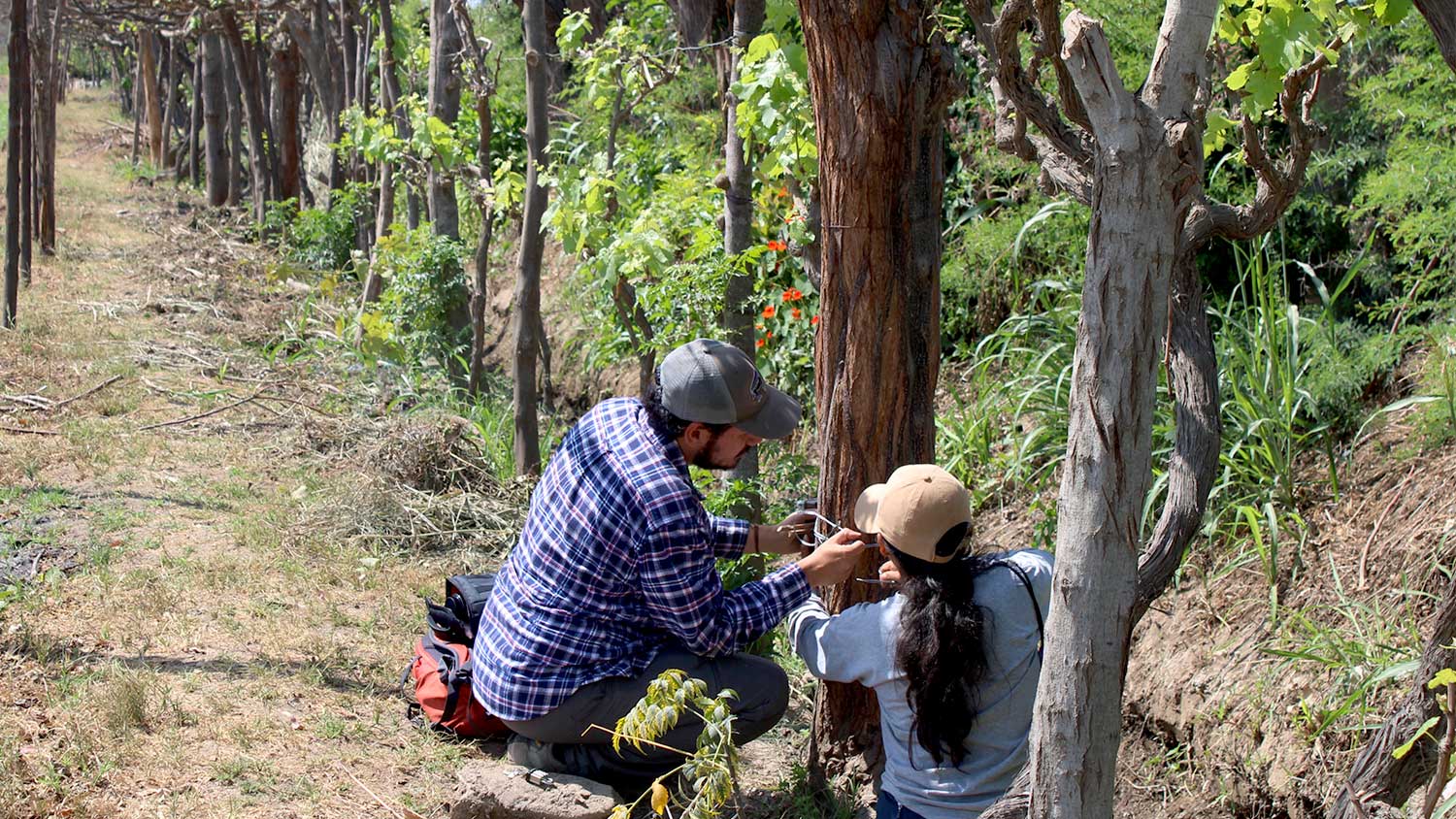
YSE students can supplement and expand their coursework in food systems and agriculture with independent work. Most often, this will be research or an independent project.
Research
YSE students pursuing an MESc, MFS, or PhD can pursue independent research on food and agriculture. MESc and MFS students typically complete their fieldwork during the summer between their first and second years, and apply for funding through the Career and Professional Development Office or external grants and fellowships.
Examples of Research:
-
Kristen Tam - Master of Environmental Science '26
Kristen's research focuses on quantifying greenhouse gas (GHG) fluxes—specifically CO₂, CH₄, and N₂O—resulting from the application of two fertilizer types: compost and liquid slurry. In collaboration with a regenerative dairy farm in New York's Hudson River Valley, she is transforming livestock manure into these fertilizers and applying them to a hay, alfalfa, and clover field used to produce winter feed for the farm's cattle. To better understand the drivers of GHG emissions, she is also conducting comprehensive soil analyses, including assessments of soil properties and microbial activity. -
Sophia Joffe Hampton – Master of Environmental Science and Juris Doctor with Vermont Law School '25
Sophia's thesis research explored how private property, as a system of legal and social relations, reifies systemic injustices in the food system. Through ethnographic methods and socio-legal analysis, she looked at agroforestry transitions in the Northeastern U.S., where land access barriers for beginning and young farmers interferes with agroforestry adoption. Within this, she looked at how alternative tenure models support inclusive and cooperative agroforestry systems. -
Gino Rivera Bulnes — Master of Environmental Science '24
Gino's research aims to shed light on the interplay between smallholder farmers, agribusinesses and wild carnivores in the Ica Valley, a hub of agricultural development in Peru. Using mixed methods, Gino studiedis studying how farmers and carnivores interact and where these interactions happen. His research helps us Not only will this help us understand how the agricultural systems—whether it's traditional small-scale farms or industrialized large estates—affect the carnivores that coexist in the landscape, but the study will also look into how they are impacted by these interactions, and why it matters. -
Sophie Roberts — Master of Forest Science '25
Sophie's research aims to expand and improve the adoption of agroforestry systems through Payments for Ecosystem Services (PES). To fund the conversion of monoculture farms to agroforestry systems, the concept of PES is gaining traction as a means to support and incentivize agroforestry. However, there is a greater need for these programs to highlight biodiversity which has thus far been a challenge. One organization that provides PES to farmers is Third Millenium Alliance (TMA) in the Pacific Forests of Ecuador. To enhance biodiversity monitoring approaches, Sophie developed a tree species classification model for the farms at TMA, leveraging high-resolution satellite imagery and deep learning techniques. Sophie also explored how socio-geographic factors influence tree diversity across farms to help guide PES initiatives and uplift farmers who need greater support to restore the environment. -
Karam Sheban — Doctor of Philosophy
Karam Sheban is a doctoral student and co-director of the Northeast Forest Farmers Coalition (NFFC). With funding through the USDA's Sustainable Agriculture Research and Education program, the NFFC conducts research and provides education around the practice of forest farming—the intentional cultivation of commercially understory herbs under a forest canopy. The goal of the Coalition is to build and support a community of practicing forest farmers across the northeast region and to build an applied research pipeline that connects practitioners and researchers around shared, relevant questions.
Academic Projects
All YSE students also have the option to complete independent projects ("Project Courses") for credit. Under the supervision of a faculty advisor, students determine the goals and scope of the project, deliverables and timelines, and the credit value. If you're interested in learning more about certain aspects of food systems and agriculture but cannot find related coursework at Yale, completing a project course could be a good option. In some instances, small groups of students interested in the same topic register together for a project course with the same faculty member. Project course advisors do not need to be one's academic advisor.
For MEM students, the capstone requirement can also be fulfilled by completing an independent capstone project instead of completing a capstone course. Like with project courses, a student would work with a faculty advisor to develop a plan, and in this case, also ensure it aligns with the goals and guiding principles of an MEM capstone experience.
Students register for project courses during the normal registration period by submitting a Project Course Description Form with the signature of the faculty member overseeing the project. Project course numbers can be found by searching by the faculty member's name in the Yale course search site. Importantly, students receiving course credit toward their degree cannot also be compensated in any way by any organization, company, group, or individual.
For questions about project courses, email academicaffairs.yse@yale.edu.
Examples of Academic Projects
-
Allie Douma — Master of Environmental Management '25
Allie used the summer between their first and second year in the MEM program to film a documentary called Protecting the Sky Blue Waters. The documentary follows activists against a proposed copper and nickel mine in Tamarack, MN. The mine is sited close to the headwaters of the Mississippi River, the Superior Lake Watershed, and many lakes home to Anishinaabe people's manoomin, also known as wild rice. While the mine is mean to provide raw materials for electric vehicles, and further branded as a "green mine," the environmental fall-out from mining on the surrounding watershed and Indigenous food systems will likely be steep and irreversible. Ultimately, the documentary asks us to question what a sustainable energy transition will look like and how we can also protect essential ecosystems and cultures. -
Alaina Geibig — Master of Environmental Management '25
Over the summer, Alaina interned with the Montezuma Land Conservancy, a land trust serving Southwest Colorado. She researched potential farmland commons models to address land access barriers faced by beginning and underrepresented farmers. Building on more than five years of community engagement, the project was guided by a shared vision of local food systems as a pathway to securing farmland for future generations, restoring Indigenous access to land, and creating economic opportunities for producers. -
Bennett Olupo — Master of Environmental Management '24
Bennett worked with Plant, Grow, Share and Project Sweetie Pie to promote food sovereignty in Minneapolis through the construction and maintenance of community gardens. In addition to this, Bennett interviewed community members involved with food justice to preserve and share their stories to uplift Black and indigenous voices in the community. Heused this experience to shape his thesis focused on food sovereignty in Black and Indigenous communities in Minnesota.